Disc VS Drum Granulation in NPK Plant
Zhengzhou SX heavy industry compound fertilizer equipment has a complete set of fertilizer granulators, such as disc granulator, drum granulator, roller granulator and rotary coating machine, which are well received by users

The disc granulator of compound fertilizer equipment adopts the overall arc structure, and the granulation rate is more than 85%. The main body of the disc granulator is equipped with three discharge outlets, which is convenient for intermittent production operation, greatly reduces the labor intensity and improves the labor efficiency.
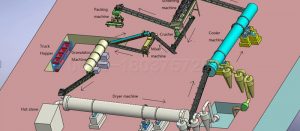
The machine and motor are driven by flexible belt. The belt starts smoothly, which reduces the impact of the buffer and prolongs the service life of the equipment. Disc granulation the bottom of the disc is reinforced by a number of radiant steel plates, which is durable and never deformed. The base of disc granulator of compound fertilizer equipment is designed to be thicker, heavier and firmer, without anchor bolts, and runs smoothly; the gear of main machine is quenched with high frequency, and its service life is doubled.
Compound fertilizer equipment disc granulator is widely used in powder, materials or small pieces of various non viscous materials. It can be used for granulation of compound fertilizer, medicine, chemical industry, feed, coal, metallurgy and other raw materials. Uniform granulation, high granulation rate, stable operation, strong equipment, long service life and other advantages.
Drum granulator is one of the key granulating equipment of compound fertilizer equipment, which is suitable for cold, hot granulation and large-scale production of high, medium and low concentration compound fertilizer. The main working method is wet granulation of agglomerates. After adjusting the humidity, the basic fertilizer will have a complete chemical reaction in the cylinder body through a certain amount of water or steam. Under certain liquid phase conditions, the rotation of the cylinder can make the material particles produce extrusion force and agglomerate into balls again.