New Ways to Make Fertilizer Granuels in 2022
Granules are an important part of organic fertilizer equipment. If organic fertilizer is made into particles, there must be organic fertilizer granulators. At present, there are several types of organic fertilizers on the market, including disc particlers, flat membrane granulators and roller extruders.
The granules are mainly performed by mixing granules, squeezing granules and spray drying.
The role of organic fertilizer equipmnent is to make organic fertilizer. Organic fertilizer granulator uses pressure to condense the solid material, and then squeeze out the material through two reverse rotating rotations, and the roller is driven by an eccentric sleeve or a hydraulic system.

When the solid material is squeezed, the air between the powder particles should be removed first to re -arrange the particles to eliminate the gap between the materials.
Organic fertilizers have several advantages after making organic manureinto fertilizer, which can make the land easier to digest, so that organic fertilizer can be quickly combined with the land. Transport, so we can put it directly into the bag to transport. The fourth warehouse is convenient for us to store it in the warehouse after air -drying, without worrying about the deterioration or rotten of organic fertilizers.
More different info on organic fertilizer machines, welcome go to https://www.fertilizerplantcost.com/
Daily troubleshooting rules for organic composting equipment
Organic composting equipment is simple and practical, and the generated fertilizer can be quickly absorbed by crops. In order to make better use of the dumper in the process of organic fertilizer manufacturing, the maintenance of chemical fertilizer equipment is very important.

1. The bearing in organic fertilizer equipment bears all the load of the machine, so good lubrication is closely related to the service life of the bearing.
2. Lubricating oil directly affects the service life and operation rate of organic fertilizer equipment. Therefore, the injected lubricating oil must be clean and well sealed. The main oil filling parts of the machine are rotating shaft roller bearing, gear movable bearing and sliding surface.
3. Newly installed tires are easy to loosen and should be checked frequently.
4. Pay attention to the normal operation of all parts of the upender.
5. Pay attention to check the wear degree of the easily worn parts of the lathe, and replace the worn parts at any time.
6. Dust and other sundries shall be removed from the underframe plane of the movable device of the upender to avoid serious accidents caused by the movable bearing unable to move on the underframe when the machine encounters immovable materials. Broken.
7. When the lathe rotates the gear, if there is an impact sound, stop immediately for inspection and eliminate it.
Organic composting equipment
In the manufacture of NPK fertilizer and organic fertilizer, it is necessary to make a detailed description and solutions to the wear of machine parts and the common faults in the operation manual. On the other hand, routine maintenance is more important. Compliance routine maintenance can effectively reduce failures and prolong service life.
Compost Turner for Pollution Treatment by Poultry Farm Manure
With the rapid development of intensive and large-scale breeding of livestock and poultry in China, the pollution of feces discharged from farms to the surrounding environment is becoming more and more serious. A large number of livestock manure is not used as resources, which has become one of the main causes of non-point source pollution in agricultural production.
In the face of the demand of a large amount of livestock manure and biological fertilizer projects, they are composted, harmless treated, and then reused to make high-quality biological organic fertilizer. The pollution of feces to the environment can promote the development of green agriculture.

Compost fermentation is an important part of livestock manure organic fertilizer production line. Turning over is an important measure to improve composting efficiency and quality. In the process of organic composting, the composting of modern industrialized livestock and poultry manure consumes a lot of human, material and financial resources. Developing corresponding production equipment can save time and effort. With the development of livestock manure composting technology, a number of special machinery for livestock manure turning and composting have been developed in the market.
The tipping machine includes walking fermentation tank, walking track, power intelligent control device, tipping bucket tipping section and tipping device (also known as moving car, which is mainly used in the case of multiple tanks). The working part of the dump pile adopts advanced electric drive, which can be lifted or not. The lifting type is mainly used when the tank width is no more than 5m and the dump depth is no more than 1.3m. It is suitable for the fermentation of livestock manure, sludge garbage, sugar filter mud, tank residue cake, straw sawdust and other organic wastes.

It is widely used in organic fertilizer plants, compound fertilizer plants, sludge and garbage plants, gardening, etc. Fermentation and dehydration operations on farms and mushroom plantations. It has the characteristics of simple operation, short fermentation cycle, sufficient fermentation and low pollution. The use of limited land area makes the large-scale harmless treatment of organic waste a reality.
More detailed info on poultry manure composting, go to https://compostmachinery.com/poultry-manure-composting/
Fertilizer FAQ
Q: what is soil testing and formulated fertilization?
A: Soil testing: testing soil nutrient content;
Formula: put forward scientific fertilization measures (ratio, dosage, period and method) according to crop fertilization law, soil fertility and fertilizer utilization rate
Q: can rice use nitrate nitrogen? No.
A: nitric oxide is easy to leach.
Q: what are physiological acid fertilizers?
A: Ammonium sulfate, ammonium chloride, etc. should be used in northern alkaline soil.
Q: Characteristics of granulating production line:
A: 1. The design of spiral section of mixing section is reasonable and unique, the mixing is uniform, and the feeding and discharging is fast
2. Computer automatic batching / mixing / packaging in one, using the cage feeding mode, small area, less labor, less investment.
3. The whole equipment is made of stainless steel, corrosion resistance, long service life.
4. The following are pictures of applicable granulation production line:

Q: what is chemical acid fertilizer?
A: Superphosphate is suitable for alkaline soil in North China.
Q: what is chemical alkaline fertilizer?
A: Phosphorus magnesium fertilizer, ash.
First of all, they can not be mixed with farmyard manure, ammonium nitrogen fertilizer and straw ash as mulching fertilizer.
Q: can urea be watered immediately?
A: No, urea is easily lost.
Do not water immediately after fertilization, it can be converted into ammonium bicarbonate in 2-3 days in summer, and the effect of re watering is better.
Q: can ammonium bicarbonate be applied to the soil surface?
A: No, it should be covered with soil. Due to the application of ammonium bicarbonate on the soil surface, most of the nutrients will volatilize into the air, and the utilization rate is very low. More details, go to https://organicfertilizerplants.com/
Q: how to improve the utilization rate of phosphate fertilizer?
-A: 1. Mixed organic fertilizer.
2. Concentrated application as base fertilizer.
3. Priority should be given to winter crops and legumes;
4. Combined application of nitrogen, phosphorus and potassium.
5. Sandy soil and dry land are preferred;
6. After effect of rational utilization of phosphate fertilizer.
Q: can urea be absorbed by crop roots?
A: after urea is converted into ammonium nitrogen, it can be absorbed by crops.
Q: why is the application of potassium sulfate compound fertilizer easy to cause soil hardening?
A: the main reason is the formation of CaSO4 (gypsum).
How to make organic fertilizer granules more effcient?
About mechanical products, there will be various problems in operation. Organic fertilizer granulator is also a kind of machinery. Of course, I won’t say no problem.
So, under normal circumstances, what problems should we pay attention to? Today, Zhengzhou SX organic fertilizer machinery will mainly explain some problems that are easy to occur in the operation of the organic fertilizer granulator.
In the operation process of organic fertilizer granulator, if the configuration is not correct, it is easy to break the bearing. Of course, this problem usually occurs after a long time of use, because new machine bearings will never cause problems.

Yes. Everyone knows that the quality of a new machine is very important, so you usually don’t have to worry about quality. In general, both the granulator and other organic fertilizer equipment will be overloaded, because the domestic overtime is still serious.
So, can our equipment be used in this way? How to ensure the safety of equipment in long-term use?
For the newly installed fertilizer granulator, due to the initial operation, it is likely that there are still problems in most places, such as insufficient screw tightening, so it is necessary to check every time to avoid the machine has begun to wear, but you do not know.
For the equipment that has been used for a long time, the area that needs to be inspected has become the area prone to aging and deformation. As long as there is no problem with the equipment itself, there is usually no problem with long-term use.
However, no matter the granulator or other organic fertilizer equipment, our organic fertilizer equipment manufacturers do not recommend overloading, after all, it will consume the service life of the machine itself.
More details, go to https://organicfertilizermachines.com/
Mixer’s role in compost production line
In the process of organic compost production, different equipment of organic compost production line must be selected according to the production situation of customers.
Today, let’s look at the advantages of horizontal and double axel mixers in organic compost mixers:
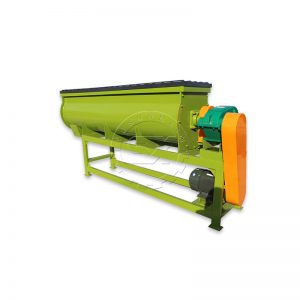
The double axis mixer uses the synchronous rotation of two symmetrical spiral shafts to add dry water and other powder materials while stirring, so that the dry powder can be humidified evenly to prevent the wet materials from releasing dry ash and water seepage. , convenient for loading and transportation of humidified ash or transfer of humidified ash to other conveying equipment. Horizontal mixer can get enough raw material mixing, thus improving the uniformity of mixing, and suitable for the mixing of compost raw materials.
The double axel mixer is mainly composed of shell, screw shaft assembly, driving device, pipeline, cover, chain cover, etc. The shell is mainly composed of plates and steel profiles, welded and formed in the manufacturing plant and assembled with other components. The shell is tightly sealed and free from the rise and leakage of fly ash.
Depending on the feasibility, the horizontal mixer is not affected by the size and density. It has a good effect on viscous substances. The stable mixing process reduces the damage to the fragile materials, and the structure of the flying knife also plays a role in crushing. The horizontal structure reduces the height of the fuselage and is easy to install. The forward and reverse screws are mounted on the same flat shaft to form a low power and high efficiency mixing environment.
Biaxial mixer
In NPK compost production line, the series of compost machines can use simple composting machine to ferment raw materials, which will be equipped with fermentation composting machine. Then, compost crusher, compost mixer and compost crusher will be equipped to deal with the raw materials. We can use chain crusher and horizontal mixer to deal with organic raw materials. Next, in the production of organic compost granulator, in the compost manufacturing process must be equipped with compost granulator.
Machines for different types of fertilizer production
What are the differences between organic and inorganic compound fertilizer, organic fertilizer and bio organic fertilizer and fertilizer equipment to be equipped on fertilizer production line?
Organic inorganic compound fertilizer is a kind of compound fertilizer containing both organic matter and chemical fertilizer. It is a kind of fertilizer obtained by harmless and effective treatment of manure, pea and other organic matter through microbial fermentation and adding appropriate amount of organic fertilizer. Fertilizer, humic acid, amino acid, etc., pelletizing or direct mixing.
Organic fertilizer is a kind of slow effect fertilizer produced by the fermentation of animal and plant residues, feces and biological waste. The main component of organic fertilizer is organic matter. After being applied to the soil, it can continuously release various nutrients for plants to absorb. Through microbial decomposition, it can provide comprehensive nutrition for long-term fertilized crops. Organic fertilizer is the main raw material for soil improvement, which can enhance the ability of soil water and fertilizer protection, improve plant yield and quality. The main nutrients of green food production.
Bio organic fertilizer produced by bio fertilizer production line sx plante is a kind of compound fertilizer by adding specific functional microorganisms to organic fertilizer. The function of bio organic fertilizer is to increase soil nutrients and improve soil biological activity. Functional bacteria and organic matter can improve the soil and promote the release of soil fixed nutrients.
They are rich in organic matter, which can improve soil structure and increase soil nutrients. Both organic-inorganic compound fertilizer and organic fertilizer contain a certain amount of nitrogen, phosphorus and potassium.
Generally, bio organic fertilizers do not contain nitrogen, phosphorus and potassium.
Organic inorganic compound fertilizer: the content of organic matter in organic-inorganic compound fertilizer is not less than 20%, and the total nitrogen, phosphorus and potassium is not less than 15%.
Organic fertilizer: the content of organic matter in organic fertilizer is not less than 30%, the content of total nitrogen, phosphorus and potassium is not less than 4%, and not more than 15%.
Bio organic fertilizer: the content of organic matter in bio organic fertilizer shall not be less than 25%, and the number of effective living bacteria shall not be less than 20 million / g.
Organic fertilizer production line
Chemical fertilizer equipment:
In the process of chemical fcompound ertilizer production, different types and series of chemical fertilizer production equipment should be equipped to complete the production process. General fertilizer production equipment mainly includes fertilizer mixer, fertilizer crusher, granulator, etc. It can be used in organic fertilizer production line.
Why compost manure before application?
What are the disadvantages of direct processing of immature agricultural products into farmland or simple drying in organic fertilizer production line? Although animal manure is a good organic fertilizer, there are many disadvantages of chemical fertilizer if immature animal manure is directly used in farmland or simply used as organic fertilizer for drying.
1. Infection of diseases and insect pests: the direct application of immature organic matter will lead to the spread of diseases and insect pests, crop diseases, and also affect the health of consumers of agricultural products.
2. In the process of chemical fertilizer production, if the raw materials are composted without organic fertilizer, they will be fermented and the seedlings will be burned: after fertilizing the unfermented raw fertilizer, the raw fertilizer will start to ferment under the condition of water and other fermentation conditions, and the heat generated by fermentation will affect the growth of agricultural crops.
3. Soil anoxia: organic matter will consume oxygen in the soil during differentiation, which will limit the growth of crops. Therefore, compost can only be used after harmless treatment.
4. Low fertilizer utilization rate: most of the unfermented and rotten organic fertilizers in the organic fertilizer production line or biological fertilizer production line are in the organic state or slow action state, which can not be directly absorbed and utilized by crops, but can only be absorbed and used after being differentiated and transformed by crops.
No need to use and transport directly, large volume and moisture content. Therefore, compost can only be used after harmless decomposition and treatment. More detailed info, welcome go to https://fertilizerplantequiment.com/
How to make chicken manure pellets at large scale?
Organic fertilizer is produced by the fertilizer production equipment with complete equipment. The raw materials can be chicken manure, cow manure, etc. various fertilizer production lines are designed according to different raw materials.

The disc pelletizing organic fertilizer production line has the advantages of low price, high cost performance and simple operation, and is especially suitable for pelletizing chicken manure organic fertilizer. Here, we will introduce the granulation technology of large-scale chicken manure pan. Organic fertilizer production line.
1. For the composting of large-scale chicken manure production line, it is usually not necessary to occupy too much space, and the walking dumper can be used for dumping and fermentation. With the gradual dehydration of materials, the cutter shaft with crushing device can effectively crush the plate formed in the fertilizer fermentation process, which not only saves the crusher, but also greatly improves the utilization rate of materials. Crushing efficiency and cost reduction fundamentally solve the problem that production capacity is affected by crushing mechanism.
2. The fermented materials are added into the disc granulator for granulation. The angle of the large disc chicken manure granulator adopts a full circle structure. In the production process, the appropriate amount of water is added to make the materials collide to form a disc granulator. The disc granulator has three outlets, which is convenient for intermittent production, greatly reduces the intensity and improves the labor efficiency.

3. After granulation, the moisture and strength of the material can not reach the standard and need to be dried. The rotary chicken manure dryer makes full use of the function of the board to make the material fully contact with the hot air generated. Through the hot blast stove, the material is dried and the strength is improved.

4. The dried and cooled materials are transported to the screening equipment through the belt conveyor to screen the granular organic fertilizer and fine powder organic fertilizer. The fine powder organic fertilizer can be sent to the disc granulator through the return belt for new granulation, forming a complete production cycle.
5. Finally, the qualified organic fertilizer is sent to the automatic packaging machine for packaging. The general fertilizer production process around these processes needs these fertilizer equipment to complete the complete production process.

The above small-scale weaving and finishing process is a complete large-scale chicken manure organic fertilizer production line process. Disc granulation organic fertilizer production line is suitable for organic fertilizer production line with an annual output of less than 10000. If you want to know more about the process of organic fertilizer equipment, please contact us. We are a professional fertilizer machinery manufacturer, and we have also designed a biological fertilizer production line to manufacture biological fertilizer Machine fertilizer.
Give Me 10 Minutes, I’ll Give You The Truth About Bio Fertilizer Production Technology
Organic fertilizer production and bio fertilizer production technology
The production line of organic fertilizer granulating machine and bio fertilizer is designed for the production of bio fertilizer granulating machine. The low price of organic fertilizer and bio organic fertilizer is due to their wide variety of raw materials.
How to use fertilizer manufacturing technology to produce bio fertilizer granulating machine in the complete bio fertilizer production line?
In the process of fertilizer production, different types of fertilizer equipment are equipped to complete the production process. The details are as follows:

Step 1: fermentation
a。 Add fermentation bacteria: 60% of livestock manure, 20% of food bacterial residue, 10% of materials with low water content such as straw (reduce water content to 40%, which is the most suitable water for fermentation), and 1% of bacterial fermenter.
The purpose of adding fungicide is to increase the temperature rising speed and control the fermentation temperature at 65 ℃ ~ 70 ℃. The peculiar smell and bactericidal effect in the fermentation process were eliminated, and the fermentation speed was accelerated, so that the fermentation time was shortened to about 15-20 days;
During fermentation, it should be noted that throwing should be carried out every 2-3 days. If the workload is too large, fermentation throwing machine can be used. The aim is to increase oxygen content, compost needs to be turned over continuously; at the same time, it can make the combination of fermentation bacteria and materials more uniform, increase maturity, and accelerate fermentation maturity.
Production of bio fertilizer
b。 Mashed potatoes after fermentation and ripening:
Because some stem rods are too large to fertilize, it is necessary to crush these materials by semi wet material crusher to prepare the next granulation (the smaller the crushed material, the easier it is to produce grains). The materials of crushing and mixing are powder, which is not conducive to mechanical fertilization.
Step 2: Granulation
If it’s an organic fertilizer manufacturer, it needs to be pelletized and sold. The price of granular organic fertilizer produced in the organic fertilizer production line is much higher than that of the ordinary fermented agricultural fertilizer. That’s why organic fertilizer is a few dollars less expensive and the profit is even more substantial.
a。 Mixing: in the production line of bio fertilizer, add proper amount of urea (and NPK) into the crushed products after fermentation, and stir evenly with horizontal mixer. The state of organic fertilizer has a significant regulatory effect because of the content of NPK.
Although the nutrients of fermented organic fertilizer are rich, NPK content still does not meet the national organic fertilizer content standard. It is necessary to add NPK to the granulation process, smash it into uniform particle size and turn them into powder, which is beneficial to granulation and fertilization.
Granulation: different granulation methods are selected according to water content and production capacity. When the output is large and the water content is high (low cost), the material is dried and cooled evenly by disc granulator to form stirring. Disc granulator is a kind of equipment used in organic fertilizer production line to produce organic fertilizer.
When the production is small and the water content is low (high cost), the mixing granulator no longer needs drying and cooling, and the granulation rate is relatively high, which can reach more than 90%, and the hardness is good and it is not easy to disperse.
c。 Screening: introduce granular materials into the sieve separator, screen and put 3mm materials directly into the packaging link. They can be sold as commodities: Materials less than 3mm that do not meet the standards shall continue until the diameter reaches the standard; return particles larger than 3mm to grinding stage and then make grains.
Compared with traditional composting, organic fertilizer has more development and mature process, and deodorant is added. Therefore, in the process of bio fertilizer production, there is no peculiar smell, and the mature organic fertilizer will not produce secondary maturity in sowing.
At the same time, because of the rich nutrients, the soil structure can be improved and soil hardening avoided; in the seedling combustion; meanwhile, due to the rich nutrient elements, the soil structure can be improved and bacteria can be added to the fermentation process. In the process of decomposition, the nutrients which are not easily decomposed in soil are transformed into the form which is beneficial to plant absorption and improve soil quality.